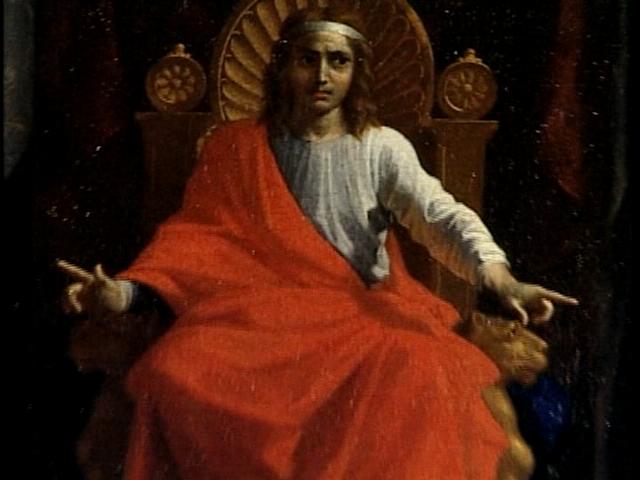
Monday, February 14, 2011

Israel Finkelstein has not archaeologically “destroyed Solomon”, as he thinks. He has completely missed Solomon.


by
 
Damien F. Mackey


Introduction
 
Israeli archaeologist, Israel Finkelstein, is quoted as saying in a recent National Geographic article, “Kings of Controversy” by Robert Draper (David and Solomon, December 2010, p. 85): “Now Solomon. I think I destroyed Solomon, so to speak. Sorry for that!” What Finkelstein ought to be “sorry” for, however, is not the wise King Solomon - who continues to exist as a real historical and archaeological entity, despite the confused utterances of the current crop of Israeli archaeologists - but for Finkelstein’s own folly in clinging to a hopelessly out-dated and bankrupt archaeological system that causes him to point every time to the wrong stratigraphical level for Israel’s Old Testament history (e.g. Exodus/Conquest; David and Solomon). Seemingly ignorant of the cosmopolitan Late Bronze Age and the 18th dynasty era of Egypt, which revisionists have now shown conclusively to have been contemporaneous with King Solomon (with the biblical King Shishak now clearly identified as pharaoh Thutmose III himself), Finkelstein and his colleagues persist with the old Sothic-based chronology of c. 1900 (together with F. Champollion’s now completely discredited identification of Shishak with Shoshenq I), which forces them to deny to Solomon and the Queen of Sheba their rightful c. C10th BC existence, relegating them instead to the impoverished Iron Age era of Israel. Thus Finkelstein (ibid., pp. 85-86):
But take Solomon, dissect it [sic]. Take the great visit of the Queen of Sheba – an Arabian queen coming to visit, bringing all sorts of exotic commodities to Jerusalem. This is a story which is an impossibility to think about before 732 B.C., before the beginning of Arabian trade under Assyrian domination. Take the story of Solomon as the great, you know, trainer in horses and chariots and big armies and so on. The world behind Solomon is the world of the Assyrian century.
But the Queen of Sheba was not “an Arabian queen”. She was, as Josephus clearly tells, ‘a ruler of Egypt and Ethiopia’. She was Queen Hatshepsut of the 18th dynasty, whose throne name, Makera (Maat-ka-re), can easily be seen in her name according to Ethiopian legend, Makeda. Her famous Punt expedition reveals this queen to have been one well capable of “bringing all sorts of exotic commodities …”. One does not have to descend to the C8th BC Assyrian era - and hence well out of Solomon’s chronological range - to discover this sort of luxurious and cosmopolitan scenario. Two El Amarna letters of the 18th Egyptian dynasty era actually refer to the “House of Solomon” (Bît Šulman), but historians - in typical Finkelsteinian fashion - have to dismiss this as long pre-dating Solomon. This evidence, amongst much else, should have led them to question their chronology.
The Tell Dan reference to the “House of David” usually receives grudging acceptance from archaeologists. Strangely - and I would say quite inconsistently - Finkelstein does accept that David was a C10th BC entity (despite his famous son Solomon’s being relegated to oblivion). Thus he says (Ibid., p. 85):
David, for example, is a historical figure. He did live in the tenth century B.C. I accept the descriptions of David as some sort of leader of an upheaval group, troublemakers who lived on the margins of society. But not the golden city of Jerusalem, not the description of a great empire in the time of Solomon.
This muddle-headed archaeologist can then say that this ‘David’ - a marginal troublemaker bearing absolutely no resemblance to the biblical King David in all his complexity and greatness - is, for him, “everything”. “If you want me to say it simplistically [which is about all that Finkelstein is capable of, apparently], I’m proud that this nobody from nowhere became the center of Western tradition”.
Draper, in his concluding sentence, will call Finkelstein “David’s dethroner”, when quoting Finkelstein, who says: “So for me, David is not a plaque on the wall, not even merely a leader of a tenth-century band. [Contrary to what he had just said] No. Much more than that”.
Does Draper suspect that Finkelstein perhaps imagines that he has now dethroned both David and Solomon? Does he presume to have obliterated them and to have taken over their throne? The King is a Fink!
Whatever Finkelstein himself might imagine, David and Solomon were real C10th BC kings. And they were, quite unlike Finkelstein, greatly endowed with wisdom.

Sunday, September 26, 2010

Biblical Amraphel Was Not Hammurabi But Lived Much Earlier


Taken from "The Wars of Gods and Men":
http://www.bibliotecapleyades.net/sitchin/sitchinbooks03_05.htm


Chapter Thirteen
ABRAHAM: THE FATEFUL YEARS


And it came to pass
in the days of Amraphel king of Shin’ar,
Ariokh king of Ellasar,
Khedorla’omer king of Elam,
and Tidhal king of Go’im -
That these made war
with Bera King of Sodom,
and with Birsha king of Gomorrah,
Shinab king of Admah,
and Shem-eber king of Zebi’im,
and with the king of Bela, which is Zoar.

"Thus begins the biblical tale, in chapter 14 of Genesis, of an ancient war that pitted an alliance of four kingdoms of the East against five kings in Canaan. It is a tale that has evolved some of the most intense debate among scholars, for it connects the story of Abraham, the first Hebrew Patriarch, with a specific non-Hebrew event, and thus affords objective substantiation of the biblical record of the birth of a nation.

"....For many decades the critics of the Old Testament seemed to prevail; then, as the nineteenth century was drawing to a close, the scholarly and religious worlds were astounded by the discovery of Babylonian tablets naming Khedorla’omer, Ariokh, and Tidhal in a tale not unlike the biblical one.

"The discovery was announced in a lecture by Theophilus Pinches to the Victoria Institute, London, in 1897. Having examined several tablets belonging to the Spartoli Collection in the British Museum, he found that they describe a war of wide-ranging magnitude, in which a king of Elam, Kudur-laghamar, led an alliance of rulers that included one named Eri-aku and another named Tud-ghula - names that easily could have been transformed into Hebrew as Khedor-la’omer, Ariokh, and Tidhal. Accompanying his published lecture with a painstaking transcript of the cuneiform writing and a translation thereof, Pinches could confidently claim that the biblical tale had indeed been supported by an independent Mesopotamian source.

"With justified excitement the Assyriologists of that time agreed with Pinches reading of the cuneiform names. The tablets indeed spoke of "Kudur-Laghamar, king of the land of Elam"; all scholars agreed that it was a perfect Elamite royal name, the prefix Kudur ("Servant") having been a component in the names of several Elamite kings, and Laghamar being the Elamite epithet-name for a certain deity. It was agreed that the second name, spelled Eri-e-a-ku in the Babylonian cuneiform script, stood for the original Sumerian ERI.AKU, meaning "Servant of the god Aku," Aku being a variant of the name of Nannar/Sin. It is known from a number of inscriptions that Elamite rulers of Larsa bore the name "Servant of Sin," and there was therefore little difficulty in agreeing that the biblical Eliasar, the royal city of the king Ariokh, was in fact Larsa. There was also unanimous agreement among the scholars for accepting that the Babylonian text’s Tud-ghula was the equivalent of the biblical "Tidhal, king of Go’im"; and they agreed that by Go’im the Book of Genesis referred to the "nation-hordes" whom the cuneiform tablets listed as allies of Khedorla’omer.

"Here, then, was the missing proof - not only of the veracity of the Bible and of the existence of Abraham, but also of an international event in which he had been involved!

"....The second discovery was announced by Vincent Scheil, who reported that he had found among the tablets in the Imperial Ottoman Museum in Constantinople a letter from the well-known Babylonian King Hammurabi, which mentions the very same Kudur-laghamar! Because the letter was addressed to a king of Larsa, Father Scheil concluded that the three were contemporaries and thus matched three of the four biblical kings of the East - Hammurabi being none other than "Amraphael king of Shin’ar."

"....However, when subsequent research convinced most scholars that Hammurabi reigned much later (from 1792 to 1750 B.C., according to The Cambridge Ancient History), the synchronization seemingly achieved by Scheil fell apart, and the whole bearing of the discovered inscriptions - even those reported by Pinches - came into doubt. Ignored were the pleas of Pinches that no matter with whom the three named kings were to be identified - that even if Khedorla’omer, Ariokh, and Tidhal of the cuneiform texts were not contemporaries of Hammurabi - the text’s tale with its three names was still "a remarkable historical coincidence, and deserves recognition as such." In 1917, Alfred Jeremias (Die sogenanten Kedorlaomer-Texte) attempted to revive interest in the subject; but the scholarly community preferred to treat the Spartoli tablets with benign neglect.

"....Yet the scholarly consensus that the biblical tale and the Babylonian texts drew on a much earlier, common source impels us to revive the plea of Pinches and his central argument: How can cuneiform texts, affirming the biblical background of a major war and naming three of the biblical kings, be ignored? Should the evidence - crucial, as we shall show, to the understanding of fateful years - be discarded simply because Amraphel was not Hammurabi?

"The answer is that the Hammurabi letter found by Scheil should not have sidetracked the discovery reported by Pinches, because Scheil misread the letter. According to his rendition, Hammurabi promised a reward to Sin-Idinna, the king of Larsa, for his "heroism on the day of Khedorla’omer." This implied that the two were allies in a war against Khedorla’omer and thus contemporaries of that king of Elam.

It was on this point that Scheil’s find was discredited, for it contradicted both the biblical assertion that the three kings were allies and known historical facts: Hammurabi treated Larsa not as an ally but as an adversary, boasting that he "overthrew Larsa in battle," and attacked its sacred precinct "with the mighty weapon which the gods had given him."

"A close examination of the actual text of Hammurabi’s letter reveals that in his eagerness to prove the Hammurabi-Amraphel identification, Father Scheil reversed the letter’s meaning: Hammurabi was not offering as a reward to return certain goddesses to the sacred precinct (the Emutbal) of Larsa; rather, he was demanding their return to Babylon from Larsa.

"....The incident of the abduction of the goddesses had thus occurred in earlier times; they were held captive in the Emutbal "from the days of Khedorla’omer"; and Hammurabi was now demanding their return to Babylon, from where Khedorla’omer had taken them captive. This can only mean that Khedorla’omer’s days were long before Hammurabi’s time.

"Supporting our reading of the Hammurabi letter found by Father Scheil in the Constantinople Museum is the fact that Hammurabi repeated the demand for the return of the goddesses to Babylon in yet another stiff message to Sin-Idinna, this time sending it by the hand of high military officers. This second letter is in the British Museum (No. 23,131) and its text was published by L.W. King in The Letters and Inscriptions of Hammurabi.

"....That the goddesses were to be returned from Larsa to Babylon is made clear in the letter’s further instructions.

"....It is thus clear from these letters that Hammurabi - a foe, not an ally, of Larsa - was seeking restitution for events that had happened long before his time, in the days of Kudur-Laghamar, the Elamite regent of Larsa. The texts of the Hammurabi letters thus affirm the existence of Khedorla-omer and of Elamite reign in Larsa ("Ellasar") and thus of key elements in the biblical tale.

Friday, June 4, 2010

Jesus Christ, the Geatest of David's Royal Dynasty


What does it mean that Jesus is the son of David?


Jesus son of David

Question: "What does it mean that Jesus is the son of David?"

Answer:
Seventeen verses in the New Testament describe Jesus as the "son of David." But the question arises, how could Jesus be the son of David if David lived approximately 1000 years before Jesus? The answer is that Christ (the Messiah) was the fulfillment of the prophecy of the seed of David (2 Samuel 7:14-16). Jesus was the promised Messiah, which meant He was of the seed of David. Matthew 1 gives the genealogical proof that Jesus, in His humanity, was a direct descendant of Abraham and David through Joseph, Jesus' legal father. The genealogy in Luke chapter 3 gives Jesus' lineage through His mother, Mary. Jesus is a descendant of David, by adoption through Joseph, and by blood through Mary. Primarily though, when Christ was referred to as the Son of David, it was meant to refer to His Messianic title as the Old Testament prophesied concerning Him.

Jesus was addressed as “Lord, thou son of David” several times by people who, by faith, were seeking mercy or healing. The woman whose daughter was being tormented by a demon (Matthew 15:22), the two blind men by the wayside (Matthew 20:30), and blind Bartimaeus (Mark 10:47), all cried out to the son of David for help. The titles of honor they gave Him declared their faith in Him. Calling Him Lord expressed their sense of His deity, dominion, and power, and by calling Him “son of David,” they were professing Him to be the Messiah.

The Pharisees, too, understood what was meant when they heard the people calling Jesus “son of David.” But unlike those who cried out in faith, they were so blinded by their own pride and lack of understanding of the Scriptures that they couldn’t see what the blind beggars could see – that here was the Messiah they had supposedly been waiting for all their lives. They hated Jesus because He wouldn’t give them the honor they thought they deserved, so when they heard the people hailing Jesus as the Savior, they became enraged (Matthew 21:15) and plotted to destroy Him (Luke 19:47).

Jesus further confounded the scribes and Pharisees by asking them to explain the meaning of this very title. How could it be that the Messiah is the son of David when David himself refers to Him as “my Lord” (Mark 12:35-37)? Of course the teachers of the law couldn’t answer the question. Jesus thereby exposed the Jewish spiritual leaders’ ineptitude as teachers and their ignorance of what the Old Testament taught as to the true nature of the Messiah, further alienating them from Him.

Jesus Christ, the only son of God and the only means of salvation for the world (Acts 4:12), is also the son of David, both in a physical sense and a spiritual sense.
....

Taken from: http://www.gotquestions.org/jesus-son-of-david.html

Zechariah 12: House of David

Chapter 12

1 The burden of the word of the LORD for Israel, saith the LORD, which stretcheth forth the heavens, and layeth the foundation of the earth, and formeth the spirit of man within him.
2 Behold, I will make Jerusalem a cup of trembling unto all the people round about, when they shall be in the siege both against Judah and against Jerusalem.
3 And in that day will I make Jerusalem a burdensome stone for all people: all that burden themselves with it shall be cut in pieces, though all the people of the earth be gathered together against it.
4 In that day, saith the LORD, I will smite every horse with astonishment, and his rider with madness: and I will open mine eyes upon the house of Judah, and will smite every horse of the people with blindness.
5 And the governors of Judah shall say in their heart, The inhabitants of Jerusalem shall be my strength in the LORD of hosts their God.
6 In that day will I make the governors of Judah like an hearth of fire among the wood, and like a torch of fire in a sheaf; and they shall devour all the people round about, on the right hand and on the left: and Jerusalem shall be inhabited again in her own place, even in Jerusalem.
7 The LORD also shall save the tents of Judah first, that the glory of the house of David and the glory of the inhabitants of Jerusalem do not magnify themselves against Judah.
8 In that day shall the LORD defend the inhabitants of Jerusalem; and he that is feeble among them at that day shall be as David; and the house of David shall be as God, as the angel of the LORD before them.
9 And it shall come to pass in that day, that I will seek to destroy all the nations that come against Jerusalem.
10 And I will pour upon the house of David, and upon the inhabitants of Jerusalem, the spirit of grace and of supplications: and they shall look upon me whom they have pierced, and they shall mourn for him, as one mourneth for his only son, and shall be in bitterness for him, as one that is in bitterness for his firstborn.
11 In that day shall there be a great mourning in Jerusalem, as the mourning of Hadadrimmon in the valley of Megiddon.
12 And the land shall mourn, every family apart; the family of the house of David apart, and their wives apart; the family of the house of Nathan apart, and their wives apart;
13 The family of the house of Levi apart, and their wives apart; the family of Shimei apart, and their wives apart;
14 All the families that remain, every family apart, and their wives apart.


And from: http://www.sungenisandthejews.com/uploads/ROOT-LINK.doc.

The “Root” of Romans 11


Question: Who or what is the “root” that St. Paul writes about in Romans 11?


Answer: In Romans 11, St. Paul writes at length about God’s relationship with the Israelite people. In particular he focuses on understanding the fact that so many of his Jewish brethren have not accepted the promised Messiah. Did this mean that the children of Israel were rejected by God? And what implications did this have for the Gentiles?


St. Paul then writes:


For if their (the Jews’) rejection is the reconciliation of the world, what will their acceptance be but life from the dead? If the firstfruits are holy, so is the whole batch of dough; and if the root is holy, so are the branches.

But if some of the branches were broken off, and you, a wild olive shoot, were grafted in their place and have come to share in the rich root of the olive tree, do not boast against the branches. If you do boast, consider that you do not support the root; the root supports you. Indeed you will say, ‘Branches were broken off so that I might be grafted in.’ That is so. They were broken off because of unbelief, but you are there because of faith. So do not become haughty, but stand in awe. For if God did not spare the natural branches, perhaps he will not spare you either. (Rom. 11: 15-22)


So, who or what exactly is the “root” to which St. Paul refers? It would seem that a very common answer is the Patriarchs of Israel. Although, there is certainly solid evidence that “root” may also refer to Jesus Christ, the Israelite par excellence. And there is some evidence that it may be considered to refer to Israel itself, including a statement by our current pontiff.


Perhaps these varying interpretations reveal a deeper truth, not a contradiction. To be grafted onto the Patriarchs of Israel, Israel itself or Jesus Christ (the Israelite par excellence) may amount to the same thing in the imagery St. Paul chose. It is God’s life-giving grace that flows through the roots and trunk of the tree, grace which is mediated to the branches. In human terms, the life-giving grace of God has been mediated to men through Abraham and the Patriarchs of Israel, Israel itself and of course Jesus Christ, the Israelite par excellence, the representative head of Israel (Galatians 3).


In Scripture, Isaiah prophesied that Christ would sprout forth from the “stump of Jesse”, the father of King David (Isaiah 11:1). Jacob/Israel and Judah are spoken of as “taking root” in Isaiah 27:6 and 37:31, respectively. The Old Testament expressly describes Israel as the olive tree in Jer. 11:16 and Hos 14:7. And Christ is clearly spoken of as the “root” in Revelation 5:5 and 22:16. God’s grace was showered upon man because of and through the faith of Abraham, and continued in this way through certain of his progeny, eventually passing through Jacob (Israel) and culminating in the Israelite par excellence, Jesus Christ.


Below are several interpretations from the Fathers of the Church and various Catholic scripture scholars, including Benedict XVI:


1) A Comprehensive Catholic Commentary, Fr. George Leo Haydock, page 1,494.


“By the root, says St. Chysostom, he understands Abraham and the Patriarchs, from whom all the Jewish nation proceeded, as branches from that root…”


2) Moffat New Testament Commentary: The Epistle to the Romans, page 178.


“The ‘root’ is the patriarchs”


3) Catholic Commentary on Holy Scripture 1951, Dom Bernard Orchard, page 1072 and 558, respectively:


“(St. Paul) is no renegade, and Israel…has not lost the holiness which she inherited from the Patriarchs, who are…her roots.”


“’In the days to come, Israel shall take root…’ The world’s salvation is from Israel.”


4) Fr. Richard Stack, Lectures on the Epistle of St. Paul to the Romans, 1806, page 330:


“By the root is meant Abraham…”


5) Fr. Charles Callan, The Epistles of St. Paul, page 184:


“The firstfruit and the root mean the Patriarchs, Abraham, Isaac, Jacob, etc. who were holy men and faithful servants of God.”


6) Joseph Cardinal Ratzinger (Benedict XVI), Many Religions- One Covenant, page 32:


“we must .. first ask what this view of the historical figure of Jesus means for the existence of those who know themselves to be grafted through him onto the 'olive tree Israel', the children of Abraham.” (Note: Here Benedict XVI clearly sees the Gentiles as being grafted on to Israel).


7) St. Cyril of Jerusalem (Catechetical Lectures, XX, 3) Nicene and Post-Nicene Fathers, Philip Schaff, pg 147:


“Then, when ye were stripped, ye were anointed with exorcised oil, from the very hairs of your head to your feet, and were made partakers of the good olive-tree, Jesus Christ. For ye were cut off from the wild olive-tree, and grafted into the good one,

and were made to share the fatness [abundance] of the true olive tree.

The exorcised oil therefore was a symbol of the participation of

the fatness of Christ, being a charm to drive away every trace of

hostile influence.”


8) St. Augustine:


Sermons, XXVII, 12:


"Therefore did the Lord at once graft the wild olive into the good olive tree. He did it then when He said, 'Verily I say unto you, I have not found so great faith, no, not in Israel.”


"So then for this reason that people did not come to Him, that is by reason of pride; and the natural branches are said to be broken off from the olive tree, that is from that people founded by the Patriarchs."


Augustine to Faustus the Manichean, Bk 9 2:


"You say that the apostle, in leaving Judaism, passed from the bitter to the sweet. But the apostle himself says that the Jews, who would not believe in Christ, were branches broken off, and that the Gentiles, a wild olive tree, were grafted into the good olive, that is, the holy stock of the Hebrews, that they might partake of the fatness of the olive."


9) The Catechism of the Catholic Church (#755):


The Church is a cultivated field, the tillage of God. On that land the ancient olive tree grows whose holy roots were the prophets.


10) Ancient Christian Commentary on Scripture (Romans), Bray (Editor), p 293:


a) Diodore: “First fruits and root both refer her to the patriarchs, the lawgiver and the prophets.”


b) Pseudo-Constantius: “The root refers to Abraham…”


c) Theodore of Mopsuestia: “by root he means, Abraham…”


d) Theodoret of Cyr; “the root is Abraham…”


e) Pelagius: “Do not rejoice in the fall of the Jews…you do not supply them with life, but they supply you.” (Here Pelagius seems to see Israel, or the Jews, as the root that mediates God’s grace.)


f) Ambrosiaster: “the Jews were not rejected for the sake of the Gentiles. Rather it was because they were rejected that they gave an opportunity for the gospel to be preached to the Gentiles. If you boast against those onto whose root you have been grafted, you insult the people who have accepted you so that you might be converted…You will not continue like that if you destroy the thing on which you stand.” (Here Ambrosiaster seems to be saying that the Gentiles “stand” on the Jews, that they have been grafted onto them.)


g) Chysostom: “if the Gentile, who was cut off from his natural fathers and come, contrary to nature, to Abraham, how much more will God be able to recover his own!”

h) Chrysostom: Ver. 16. "For if the first-fruits be holy, the lump also is holy; and if the root be holy, so are the branches;"

So calling in this passage by the names of the first-fruit and root Abraham, and Isaac, and Jacob, the prophets, the patriarchs, all who were of note in the Old Testament; and the branches, those from them who believed. (Homilies on Romans, Homily XIX)

i) Pseudo-Constantius: “Paul says that the Gentiles have been grafted against nature onto the root, that is, onto the faith of the Patriarchs.”


Michael Forrest

Wednesday, February 10, 2010

David and Solomon as Models for Plato's Philosopher King


Taken from:
http://apaul-solomonsmind.blogspot.com/2008/01/platos-republic.html


Wednesday, January 2, 2008


Plato's Republic

After church one day, I spoke to a friend and I brought up a thought I had during the service about David and Solomon being the first Philosopher Kings. Everything I heard about Plato’s Philosopher kings was that he led by great wisdom. I started to think if Plato used Solomon as the cornerstone of his work “The Republic”? Solomon, being the wisest man the world has known, brought great wealth and power to Israel and the people were at peace. He would have been the perfect person to base a great leader on. Plus Plato lived in the 4th Century BC. Plus he traveled greatly during the time including a trip to Judea before writing this Classic. This peaked my interest, that perhaps the great Philosopher King that the earthly world is clamoring for is based on Solomon? I had to do more research. I had read many accounts of “The Republic” but I had never read the Dialogue, so I read the work and here is what I found.

The Dialogues of Plato are written almost as plays, that places his old mentor Socrates as the central character. Plato seems to explain his thoughts through the interaction of Socrates with the other characters in the story. The Republic starts as Socrates and a few friends going to a festival and they start talking about philosophy of a just man, then move into a story of the best government for the people and who should lead it. All through this Dialogue he uses Socrates’ questioning style to maneuver the other characters into his line of thought. He speaks about leaders and being a just ruler by stating that a just ruler does thing for the weak the same way that a Doctor does things for the sick and not the healthy, and the same way a captain does things for the good of the crew not what is good for him.

Then he goes on and describes justice and praises the just man. Socrates’ friend gives a description of the purely unjust man and shows how a perfectly unjust man will seam like the most just man of all. They state that the truly unjust man will go about it in the truly right way and gets away with it. The one that is not perfectly unjust will gets caught and is considered incompetent and is not the perfectly unjust, since perfect injustice consists of appearing just when you are not. The perfectly unjust man will have reputation of being the most just man. Then we need to contrast him with the “truly” just man. He is a simple and honorable man that does not appear to be just. We must deprive him of the appearance of justice because the appearance of justice will bring him recognition and rewards and then it will not be clear if his motive for justice was a desire for justice or a desire for the rewards and the recognition. This I disagree with completely, that a perfectly just man will not care of the view of others. He will do what is just and leave it at that, not boasting or using this deed. Plato contends that we must strip him of everything but justice. He must have the worst possible reputation for injustice but truly being just, and have this reputation until his death. This description almost makes me think that Plato has a premonition of the only truly just man. Does not Christ meet every aspect of the truly just man listed above? Was he not given a criminal’s death when he was completely just? They then talk of the life that awaits them both here on earth. The unjust man would ask to rule cities because he has the reputation of justice. He can marry who he likes and make contract and partnership with who he wants. He finds it easy to make himself a rich man because he has no compunction about acting unjustly. And the just man is nothing of the sort. He just receives a cross to bear (These are my words).

Socrates defends the just man. And he gives the just man three elements to being just; Courage, Wisdom, Temperance or Self-discipline. First Socrates changes the subject to a just city but intends to describe the just man with the description of the just city. They start with the origin of a city. He starts stating that the origin of a city is because not one of us is self sufficient and need others. He starts talking about how a city is formed and what makes a just city and come to conclusion that a just city is just because of its rulers are just. At this point, he explains that citizens should be classified into four types, the Gold, the Silver, the Bronze and Iron. Gold should be the ruling class and would be the best of the people. They should be trained to be the most just and wise. They should also be removed from the need for money and therefore not be restrained by greed. They should learn the needs of the people and learn what is best for the people. The Silver would be the warrior class and the other lesser important leader roles like doctors and such. And next would be the Bronze and lower classes. These are the common people that need leaders.

The guardian class or Gold class would live communally and would need for nothing except the needs of their people. They would learn from an early life the philosophy and manager skills to run a city. Socrates finally states that these leaders should be Philosophy Kings, for only the Philosopher can have the wisdom to run such a city. He states that these rulers should do whatever is needed to better the lives of the people. Then a question on the women and the children come up, and he comes to say that the families for the ruling class should be in common, that women should be treated the same as the guardian men, each man with knowledge of each women and not knowing his children. With children he states, that the best class should reproduce and have many children and with the lower classes it would only be best that the embryos never see the light of day. This is also the view of any deformed children; only the best people should be born, not the lesser people.

After defining the just city he returns to the just man and states that the just man would be one that does what he is best suited to do; a hunter being a hunter, a farmer being a farmer, a bronze man being a bronze man and a ruler being a ruler. A hunter should not be a ruler because he does not have the skills to be a ruler. Only one trained to rule should rule.
All in all I came from this book with a greater understanding of the liberal view of today’s society. The leaders of the liberal view feel that they are Philosopher Kings in charge of a great just city, and they are the great defender of this city. These are the same liberals that called for free love and communal living in the 60‘s. They force abortion on the lower classes and try to destroy the common people’s society by degrading the value of marriage. All of this thought came not just from Plato, but also from Rousseau and Voltaire. Rousseau and Voltaire shouted “let us make a heaven here on earth and forget about God. Let us rely on reason and human understanding.” These are the same people that attempted at trying to have Enlighten Despots in many European nations, that would rule a nation like these Philosopher Kings of Plato and Socrates, but they all failed with huge amounts of bloodshed; with the French Revolution the bloodiest of all.

In all of these descriptions of the just man I saw one thing. The just man that they described is the perfectly unjust man of the first part of the story. "...The truly unjust man goes about it in the truly right way and gets away with it. The one that gets caught is considered incompetent since perfect injustice consists of appearing just when you are not. They will have the reputation of being the most just man..." They gave this statement when describing the unjust man. Does the Just man in the second part of the story not sound like he will have the gone about it in the right way? This just man lies to his people because “The end justifies the means” and ends up doing what is not just for all the people; only the ruling class. He does all of this in the guise of making the best choices for the society.

Plato tried to introduce his great leader as a man that uses his great human reasoning ability. He believed that man’s wisdom could create a society that was perfectly just, but he did not want to admit that man could never be perfectly just. That ingrained into him was something that would always move to the evil inside of his spirit. Since he lived only a couple hundred years after the greatest part of Israel‘s history, Plato must of known of the story of how David and Solomon ruled with great wisdom and created a great and just nation. He must have known that with this great wisdom that each man ended up doing unjust things after failing to follow God’s guidance. So in the end even Solomon, whom was considered the wisest man ever to live, that had great courage, and was very self-disciplined, ended up becoming unjust to his people and led them astray.

I will say that at the same time of the Enlightenment and the attempts of Philosopher Kings in Europe, a group of castaways in the new world created a different republic that was not formed in the image of Plato’s Republic, but in the theory that each individual is as great as another and getting representatives from all the people would create a truly just nation. They based there nation on something different then man’s wisdom; God’s wisdom. Thomas Jefferson, who admired the French enlightened leaders as a Deist, still spent many a line on the importance of God in society. As is written in a Memorial dedicated to this man are these words.
God who gave us life gave us liberty. Can the liberties of a nation be secure when we have removed a conviction that these liberties are the gift of God? Indeed I tremble for my country when I reflect that God is just. That his justice cannot sleep forever. Commerce between Master and Slave is Despotism. Nothing is more written in the book of fate then that these people are to be free.

This Book of Plato’s does give good information, but not of the proper enlightened government, but of the folly of man’s justice. As Solomon has shown us, man can rule justly, as long as he follows the guidance of the truly just man, Jesus Christ.

Friday, September 11, 2009

Biblical ‘Queen of Sheba’ A Mystery to Modern Historians


Now when the Queen of Sheba heard of the fame of Solomon concerning the Name of the Lord, she came to test him with hard questions. She came to Jerusalem with a very great retinue, with camels bearing spices, and very much gold, and precious stones; and when she came to Solomon, she told him all that was on her mind. And Solomon answered all her questions; there was nothing hidden from the king which he could not explain to her. And when the Queen of Sheba had seen all the wisdom of Solomon, the Palace that he had built, the food of his table, the seating of his officials, and the attendance of his servants, their clothing, his cup-bearers, and his burnt offerings which he offered at the Temple of the Lord, there was no more spirit in her.
And she said to the king, "The report was true which I heard in my own land of your affairs and of your wisdom, but I did not believe the reports until I came and my own eyes had seen it; and behold, the half was not told me; your wisdom and prosperity surpass the report which I heard. Happy are your wives! Happy are these your servants, who continually stand before you and hear your wisdom! Blessed be the Lord your God, who has delighted in you and set you on the throne of Israel! Because the Lord loved Israel for ever, He has made you king, that you may execute justice and righteousness".
Then she gave the king a hundred and twenty talents of gold, and a very great quantity of spices, and precious stones; never again came such an abundance of spices as these which the Queen of Sheba gave to King Solomon.
Moreover the fleet of Hiram, which brought gold from Ophir, brought ... a very great amount of almug wood and precious stones.
... And King Solomon gave to the Queen of Sheba all that she desired, whatever she asked besides what was given her by the bounty of King Solomon. So she turned and went back to her own land, with her servants. (Cf. I Kings 10:1-11,13 & II Chronicles 9:1-10, 12).


The modern reader of the biblical story of King Solomon and the Queen of Sheba delights in it just as did the reader in the distant past. The picture of courtly elegance and grandeur, the display of cleverness and wisdom, friendship between the two heads of state, the exchange of costly gifts, and the exclamation of surprise on the part of the queen upon seeing Solomon's wealth and witnessing his display of wisdom - these are images that kindle the imagination of the simple and sophisticated alike.
Still, as J. Pritchard has noted (in Solomon & Sheba, Phaidon, p. 7), the twentieth century reader also likes to pose questions regarding the factual nature of this story:


What, if any, historical evidence is there for the celebrated visit? Has modern archaeology uncovered the remains of the age of Solomon sufficiently to make credible the details of the story? What is known from other sources about the ancient kingdom of Sheba and its queens? What appeal did this romantic tale have that could account for its continuing popularity through three millennia?


Questions, questions, but no firm answers.


It was left to Dr. Immanuel Velikovsky (Ages in Chaos, I) to identify this legendary queen, as the great Queen Hatshepsut of Egypt’s 18th Dynasty, who became ruler of Egypt an Ethiopia.


We have greatly developed Velikovsky’s pioneering work. The answers to all of Pritchard’s questions, and more, can be found in the articles at this site.

Tuesday, September 8, 2009

A Correction Re Name of Prophet Samuel


Damien F. Mackey writes:

I had once surmised that the name, Samuel, might have been of Egyptian origin, and this has been picked up at:

http://www.faithfreedom.org/forum/viewtopic.php?t=27089&postdays=0&postorder=asc&start=45

as follows
:

Samuel
It could be that the name `Samuel' is of Egyptian origin according to Damien Mackey. In that case `Moses, or Mu-sa (re) could be read Sa-Mu, with God `El', replacing the Egyptian theophoric, Re.


What it means for Israel to desire a king to rule over them - 1. Samuel 8. 8:1 And it came to pass, when Samuel was old, that he made his sons judges over Israel"".
....

I was quite wrong about this, as the First Book of Samuel distinctly tells us the meaning of the name (as referred to by Wikipedia):
According to 1 Samuel 1:20, Hannah named Samuel in memory of her requesting a child from God and God listening. Samuel is translated as Heard of God or possibly as a sentence "God has heard" (from 'Shama', heard and 'El', God — with "Shama" as the verb and "El" as the subject).[1]

Friday, March 27, 2009

Influence of Kings David and Solomon on Hatshepsut of Egypt


A. The Scriptural Influence

Hatshepsut must have dispatched her expedition to Punt near to the very beginning of her reign (that is, about the seventh year of Thutmose III), because in the ninth year she gathered together all of her nobles and proclaimed before them the great things that she had done at the behest of her father Amon-Ra. Senenmut and Nehesi were given places of honour while she recounted to the assembly the result of her great venture. Hatshepsut reminded them all of Amon's oracle commanding her "... to establish for him a Punt in his house, to plant the trees of God's Land beside his temple in his garden, according as he commanded".

(i) An Image from Genesis

It is at the conclusion of Hatshepsut's speech to her nobles that we encounter a further scriptural image. Thus Baikie has commented briefly on Hatshepsut's boast that: "I have made for [Amon-Ra] a Punt in his garden at Thebes ... it is big enough for him to walk about in", that this is "a phrase which seems to take one back to the Book of Genesis and its picture of God walking in the Garden of Eden in the cool of the evening" (op. cit., 74).

(ii) An Image from Proverbs

In another, related verse of the Punt reliefs, referring to Amon-Ra's leading of the expedition to "the Myrrh-terraces ... a glorious region of God's Land", the god speaks of his creating of the fabled Land of Punt in playful terms that can only remind one of the words that Solomon wrote about Wisdom's role in the work of Creation:

"I, Wisdom ... was with [the Creator], forming all things, and was His delight every day, playing before Him at all times, playing on the surface of His earth, delighting to be with the sons of men" (Proverbs 8:12, 30-31).

In the Egyptian version there is also reference to Hathor, the goddess of wisdom:

"... it is indeed a place of delight. I have made it for myself, in order to divert my heart, together with ... Hathor ... mistress of Punt ...".

Interestingly, the original roles of the goddesses Hathor and Isis, in the prestigious Heliopolitan 'theology', were ones very similar to those of Moses' sister and mother, re-spectively (the god Horus reminding of Moses). Thus we read in Grimal (op. cit., 42-43): "Isis hid Horus in the marshes of the Delta ... with the help of the goddess Hathor, the wet-nurse in the form of a cow. The child grew up ...".
Compare this with the action of Moses's mother and sister:

"[Moses's mother] put the child in [the basket] and placed it among the reeds at the river's brink. And his sister stood at a distance .... Then his sister said to Pharaoh's daughter, 'Shall I go and call you a nurse from the Hebrew women to nurse the child for you?' ... And the child grew ..." (Exodus: 2:3-4,7,10).

(iii) Images from the Song of Songs

In the weighing scene of all the goods acquired from Punt, Hatshepsut boasts:

'His Majesty [herself] is acting with her two hands, the best of myrrh is upon all her limbs, her fragrance is divine dew, her odour is mingled with that of Punt, her skin is gilded with electrum, shining as do the stars in the midst of the festival-hall, before the whole land'.

This passage can be favourably compared with various verses from King Solo-mon's love poem, Song of Songs (also called Song of Solomon), for example: "Sweeter your love than wine, the scent of your perfume than any spice; Your lips drip honey, and the scent of your robes is like the scent of Lebanon" (4:10-11). (Cf. 4:6, 14; 5:1, 5),
The question has to be asked: Did Solomon write this poem in honour of Queen Hatshepsut? Maccoby (op. cit.) certainly believed this to be the case, for the following reasons:

1. "To a mare among Pharaoh's cavalry would I compare you, my darling" (1:9). This direct reference to Egypt seems strange if applied to an Israelite girl, but quite natural if the beloved is an Egyptian.
2. "Black am I but beautiful, O daughters of Jerusalem, like the tents of Qedar, like the curtains of Solomon. Do not gaze at me because I am swarthy, because the sun has blackened me" (1:6). The dark complexion of the female beloved, making her conspic-uous among the "daughters of Jerusalem", would not be surprising in an Egyptian woman.
3. "Who is she that cometh out of the wilderness ... perfumed with myrrh and frankincense, with all the fragrant powders of the merchant?" (3:6). According to Veli-kovsky's reconstruction, the Queen of Sheba came up to Jerusalem from the direction of the southern wilderness, travelling overland from Aqaba (Ezion-geber). Moreover, she brought with her a great store of perfumes. She gave to Solomon "a very great store of spices ... there came no more such abundance of spices as these which the Queen of Sheba gave to King Solomon" (I Kings 10:10).
4. "My mother's sons were angry with me. They made me the keeper of the vineyards, but mine own vineyard I have not kept" (1:6). It has been regarded as a great puzzle that the female here is represented as a humble vineyard-watcher, whilst elsewhere in the poem she appears as a great lady. But may it not be, asks Maccoby, that here she is speaking metaphorically about her kingdom as a "vineyard"?

[And perhaps - as I would like further to suggest - about her native religion?].

The anger of her "brothers", countrymen, may easily be understood if she were the Queen of Egypt. Her involvement with Solomon had both political and religious impli-cations that would have been unwelcome. It might well have led to the subjection of Egypt to the power of Solomon.
5. There would be no objections, however, to a match between Solomon and an Egyptian princess whose hand would not bring with it power over Egypt.
We know that Solomon did marry an Egyptian princess.

Here, I would like to slip in another comment. Previously, I had suggested that Solomon may have married Hatshepsut's daughter, Neferure, who would have been only a child at the time. I think it likely that it was in regard to the little Neferure that Solomon wrote the words: "We have a little sister, and she has no breasts" (8:8), intending these words to be understood as if having been spoken by the Egyptians.
Fittingly, then, according to Maccoby's interpretation of this verse, the Egyptians were here offering to Solomon an Egyptian princess whom he could marry, when she was old enough.
I continue with Maccoby's useful comments:

6. "O that you were as my brother ... I would lead you and bring you to my mother's house" (8:1-2). She regrets that Solomon is not an Egyptian, so that she could marry him.
"My own vineyard is before me ..." (8:12). She must return to her own country.

In Egypt, at the time of Hatshepsut, we find a very similar type of love poetry.

(iv) An Image from the Psalms

When, late in her reign, the time came for Hatshepsut to celebrate the jubilee of her father's acknowledgement of her as heiress of the land, she summoned her favourite, Senenmut, and put him in charge of the immensely difficult task of procuring from Aswan the great shafts of granite that were needed to make her two commemorative obelisks. When the obelisks had been completed, the usual, formal words were inscribed upon them. Of a different tone however, as Baikie has pointed out, were those words in-scribed at the base of the obelisks (op. cit., 88):

"The base inscriptions ... are of more importance, chiefly because they again strike that personal note which is so seldom heard from these ancient records, and give us an actual glimpse into the mind and the heart of a great woman. I do not think that it is fanciful to see in these utter-ances the expression of something very like a genuine piety struggling to find expression underneath all the customary verbiage of the Egyptian monumental formulae. After the usual recitation of the titulary and en-comium of the queen, she goes on: 'I have done this from a loving heart for my father Amen; I have entered into his scheme for this first jubilee; I was wise by his excellent spirit, and I forgot nothing of that which he exacted. My Majesty knows that he is divine'."

And then in language that according to Baikie "might have come straight out of the Book of Psalms" (had it not been for the fact that his chronology would not allow it), the queen continues:

'I did it under his command; it was he who led me. I conceived no works without his doing; it was he who gave me directions. I slept not because of his temple; I erred not from that which he commanded. My heart was wise before my father; I entered into the affairs of his heart. I turned not my back on the City of the All-Lord; but turned to it the face. I know that Karnak is God's dwelling upon earth; ... the Place of his Heart; Which wears his beauty, and encompasses those who follow him'.

Baikie continues with his insightful commentary, though blissfully unaware that it really was the Psalms, and the sapiential words of David and Solomon, that would have influenced Hatshepsut's prayer (ibid., 89):

"The sleepless eagerness of the queen for the glory of the temple of her god, and her assurance of the unspeakable sanctity of Karnak as the divine dwelling-place, find expression in almost the very words which the Psalmist used to express his ... duty towards the habitation of the God of Israel, and his certainty of Zion's sanctity as the abiding-place of Jehovah:

'Surely I will not come into the tabernacle of my house, nor go up into my bed; I will not give sleep to mine eyes, or slumber to mine eyelids. Until I find out a place for the Lord, an habitation for the mighty God of Jacob - For the Lord hath chosen Zion; he hath desired it for his habitation. This is my rest for ever; here will I dwell; for I have desired it".


B. Influence of the Temple and Its Liturgy

It is difficult to determine precisely when Hatshepsut commenced the building of her beautiful temple, "The Most Splendid of Splendours", at Deir el-Bahri. Even Dorman, in his detailed analysis, cannot arrive at a specific date; though he would place the temple's beginning very early during Hatshepsut's rule (from the seventh year of Thutmose III).
In the context of our reconstruction, it would be surprising if Hatshepsut and Senenmut, the temple's architect, had not been greatly influenced by the design of the glorious Temple in Jerusalem. This latter magnificent edifice - the plans for which it should be recalled were David's (cf. I Chronicles 28:11) - had been built about a decade earlier.
Certainly Velikovsky had urged that Solomon's Temple had provided the model for the Deir el-Bahri temple - according to his belief that Punt was Jerusalem. He had naturally, therefore, interpreted Hatshepsut's fulfilment of Amon-Ra's command, that she "establish for him a Punt in his house, to plant the trees of God's Land beside his temple, in his garden", as indicating that Hatshepsut was trying to imitate the terraces of trees sur-rounding the Temple in Jerusalem.
In a footnote, Velikovsky referred to G. Maspero's comment (in The Struggle of the Nations, 241, n.2) about the opinion of the early Egyptologist Mariette:

"Mariette, struck by the strange appearance of the edifice [Hatshepsut's temple], thought that it betrayed a foreign influence, and supposed that Queen ... [Hatshepsut] had constructed it in the model of some buildings seen by her officers in the land of Puanit [Punt]".

Intriguing too, in the light of the biblical information that Phoenician craftsmen had assisted in the building of Solomon's Temple, was Mariette's observation that Hatshepsut's temple "probably represents ... a Phoenician influence" (Quoted by Naville, op. cit., 1).

Bimson (op. cit., 16), however, was critical of Velikovsky's claim that the design of Hatshepsut's temple was based upon the Jewish model. Clearly, he argued, it was based upon the layout of the Eleventh Dynasty temple in the vicinity ...:

"Although on a smaller scale than Hatshepsut's temple, [the Eleventh Dynasty one] foreshadows it in many ways. Like Hatshepsut's, it was terraced and approached by a causeway and ramp, and had an open court with a cloister-like colonnade. There is no doubt that the designer of Hatshepsut's temple, Senmut, was inspired by [the] earlier construction".

Against the massive western cliffs of white limestone at Deir el-Bahri, that time and the sun have coloured a rosy yellow, Hatshepsut had her temple built. Into these cliffs, which form an absolutely vertical barrier, its 'holy of holies' was cut.
Of this temple, Mariette had remarked: "it is an exception and an accident in the architectural life of Egypt". (As quoted by E. Naville, op. cit.).

Mariette was not alone in his acknowledgement of the striking originality of Hat-shepsut's temple. Baikie (op. cit., 67-68) for instance, whilst admitting that the Eleventh Dynasty temple would have offered to Senenmut "... the suggestion of how it would be best to treat such a site ...", was nevertheless adamant that Hatshepsut's temple was far from being a slavish imitation of the older building:

"Since the earlier temple has been completely excavated, it has become customary to deny to Hatshepsut's architect any claim to originality in the design which he evolved for the great temple. "Hatshepsut's temple", says Dr. H.R. Hall ..., "was directly imitated from that of her predecessor, to whom, and not to her or her architect Sennemut, any praise for its sup-posed (not real) originality is due"."

But Baikie, for his part, would not have a bar of Hall's line of reasoning:

"This, however, is to carry purism to an extravagant extent. It is quite obvious that Hatshepsut and her architect took the suggestion of a terraced temple from the earlier building beside which they were placing their own; but that is the beginning and the end of their indebtedness to the earlier architect. Senmut appreciated a good suggestion when he saw it - all the more credit to him for his commonsense; but to say that he must therefore be denied any credit for originality is to set up a canon of criticism which would deprive Shakespeare of the credit for the creation of Hamlet, and Donatello of that for the creation of the Gattamelata statue. Having got his suggestion, he proceeded to glorify it, until he had produced a building which is infinitely superior ... to that of the earlier architect".

Baikie regarded the Eleventh Dynasty effort as being "stumpy and sawn-off looking compared with the grace of the successive terraces, the long ramps and the graceful colonnades of the XVIIIth Dynasty artist". The earlier temple, "if it was completed, as is suggested by a small pyramid", he went on to observe somewhat humorously:

"... deliberately sacrificed the very gain of long horizontal lines for which its terraces were designed, and which was the one possible gain of using such a design and such a site together, and put a fool's cap on the whole structure by inviting comparison between the towering cliffs and the diminutive pyramid which perked up below them".

By contrast, according to Baikie:

"Senmut's work ... disturbs us by no distracting element. Its successive stages, with their long lines of alternating light and shadow, actually emphasise, instead of competing with, the height of the giant cliffs behind them, but offer to us a totally different kind of majesty and beauty in which the work of man, no longer aspiring to rivalry with that of Nature, derives fresh loveliness from the majestic setting in which it has been placed.

Grimal's comment on the Deir el-Bahri edifice was somewhat similar, though more terse (op. cit., 211): "The great originality of Hatshepsut's complex lay in its organ-ization into a succession of terraces in which the changes in plan enabled the monument to harmonize with the natural ampitheatre of the cliffs".
Importantly Professor Breasted, an earlier admirer of the temple's design, regarded this marvellous structure as being a sure witness to the fact that the Egyptians had developed architectural styles for which the later Greeks would be credited as the origin-ators (History, 274):

"In front of the terraces were ranged fine colonnades, which, when seen from a distance, to this day exhibit such an exquisite sense of proportion and of proper grouping, as to quite disprove the common assertion that the Greeks were the first to understand the art of adjusting external colon-nades, and that the Egyptian understood only the employment of the column in the interiors".

It is clear from the above descriptions of the majestic Eighteenth Dynasty temple at Deir el-Bahri that its sweeping terraces were one of its most notable features. Similarly, as Velikovsky has pointed out (op. cit., 121):

"The Temple of Jerusalem was built upon terraces planted with trees. These terraces were cut by an ascending path. The processions of the Levites started on the lowest terrace, and as they sang they mounted the path. This explains the fact that some of their Psalms are called Shir ha-maaloth, "song of the ascent"."

More than anything else, according to Velikovsky (ibid., 121-122), it would have been the nature of the respective sites at which the temples of Jerusalem and Deir el-Bahri were built that would have determined any significant differences between them.
Velikovsky then went on to say, in regard to the temple service, that (ibid., 122):

"Not only the temple architecture but also the temple service in Egypt were given many new features. It was not until the temple of the Most Splendid at Deir el Bahari was constructed that twelve priests, with a high priest heading them, officiated before the altar. A relief on a fragment, now in the Louvre Museum, shows twelve priests divided into four orders, three in each order, and a damaged inscription over their heads reads: "... in the temple of Amon, in Most Spendid of Splendors, by the high priest of Amon ..."."

It ought not to surprise us that Hatshepsut would have copied all that she had seen pertaining to Solomon's Temple during her visit to Jerusalem, if - as we believe - she was the Queen of Sheba. For the Bible tells us how she had drunk it all in with astonishment:

"And when the Queen of Sheba had seen all the wisdom of Solomon ... his cup-bearers, and his burnt offerings which he offered at the Temple of the Lord, there was no more spirit in her. And she said to the king, 'The report was true which I heard in my own land of your affairs and of your wisdom, but I did not believe the reports until I came and my own eyes had seen it ...'.
... And King Solomon gave to the queen of Sheba all that she desired" (II Chronicles 9: 3, 4-5, 6, 12).

Including the plans of his Temple and details relating to its priesthood and liturgy?

We shall let Velikovsky have the last word on this matter, since this article would never have been written had he not provided the important synchronism between King Solomon and Queen Hatshepsut:

"The office of the high priest was established in the Egyptian service only at the time of Queen Hatshepsut. This reform in the religious service was in-troduced after the visit of the queen to the Divine Land, where shortly before the House of the Lord had been completed".